In it for the Long Run
In a nutshell
Damian Hall tells the story of FKTs, fastest known times on trails, a phenomenon that took off during covid, and of his own attempt on the Pennine Way. British places and names will be closer to home readers, but it works as inspiration for us too.
Who it's for: Anyone looking for inspiration for their own FKT, in the Czech Republic perhaps on routes like the Černá Sněžka or the SNP trail.
2020 was undoubtedly a very strange year. Almost all running races were cancelled one after another, and the start of 2021 followed the same trend. What comes next is hard to say; all we can do is take stock of what this intervention “from above” (or from a Chinese lab) brought. In the running world, perhaps only one thing. The spread of the FKT phenomenon.
What’s behind those three letters, FKT? Fastest Known Time, the fastest known time on a given route under given conditions. There are a huge number of established routes all over the world. So all you have to do is find yours and go. You’re only fighting yourself and an imaginary opponent who ran there before you. It might have been a week ago or thirty years ago.
FKT
This effort is the subject of the book by the British ultrarunner and Inov-8 ambassador. As is often the case, he too started running more or less by mistake. He ran his first half marathon in Bath while mildly obese, and the London Marathon dressed as a flushing toilet. Then it started getting more serious, and he was increasingly drawn to off-road running, or rather fell running. That has a decades-long tradition, especially in the Lake District in northern England. That’s where you’ll find probably the best-known route, the Bob Graham Round. If you complete the 106 km route with 8,200 m of climbing in under 24 hours, you join an elite club. Billy Bland held the FKT for this route for a full 36 years. Just before covid, the record was taken by the extraterrestrial Kilian Jornet, who cut almost a whole hour. That set the FKT here “for good”, so other runners have to turn their attention elsewhere.
As I said, there are lots of similar routes, and the covid era allowed runners to focus their efforts on exactly this: trying to beat the current record on a given route. It was no longer a filler between races, but proper, systematic preparation to break a record.
One of these routes became the main theme of this book. Specifically the Pennine Way (often called “the backbone of England”), 431 km long. Damian Hall worked as a journalist, and it was he who in 2012 wrote the guidebook to this trail. He surely had no idea that eight years later he would also be the one trying to set the FKT on it.
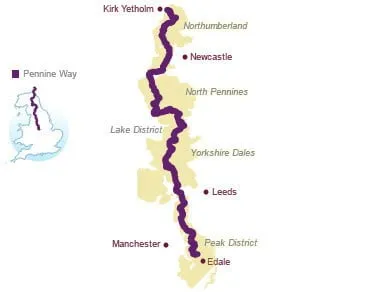
The record was set by Mike Hartley in 1989. For over 30 years no one managed to run a faster time. But the record’s time ran out in July 2020. Two elite runners, who are also good friends, announced FKT attempts. American John Kelly (one of the Barkley Marathons finishers) and Englishman Damian Hall. John started a week earlier and really did manage to snatch the record. He reached the finish after 2 days, 16 hours and 46 minutes. More than half an hour faster than Hartley. Now it’s Damian’s turn, and a bigger challenge awaits him. The book came out, so it’s clear that a week later the FKT tables for this route were rewritten again. This time by a full 3 hours and 10 minutes. (The book came out at the beginning of 2021, so it can’t know that in July 2021 John returned to the trail and took the record back. This time by 3 hours and 30 minutes…)
But the book isn’t just a summary of the preparation and the FKT attempt on this route. That’s only the last 20% or so of the book. At the beginning we read about the author’s past, how he found his relationship with running and what his path upwards looked like. Not only into the British ultrarunning team (he got there after just 4 years of running), but also, for example, his successes at UTMB.
We also read a bit about the history of running and the pitfalls of setting new records; after all, it was Damian who wrote the interesting book A Year on the Run. He starts way back in the past, when records were set in walking races and personal challenges. The world gradually sped up, and walking challenges on the same routes turned into running ones. Where there are records, there’s cheating, and Damian doesn’t avoid this topic either. Not only in the past, but also today.

A substantial part of the book is also devoted to the author’s attitude to the environment. He has no doubt that human activity has a negative impact on how our planet works. We have no planet “B” to move to. We need to take care of the one we have. The author doesn’t force this view on anyone and warns readers in advance about what’s coming in the book. If you’re not interested, you can skip back to the running. But I recommend reading it. Big things start with small individuals.

The book will no doubt be more interesting for British readers. Many of the routes Damian writes about will be more familiar to them, as will the runners who supported him. Still, I can recommend the book to us too. At the very least as a source of inspiration. Maybe you’ll decide to go for an FKT on routes being created in the Czech Republic (Černá Sněžka or PVLH) or in Slovakia (the SNP trail). And if you decide to write a book about it, don’t forget to get in touch. I’ll be happy to review it.