Let your mind run
In a nutshell
The autobiography of Deena Kastor, Olympic bronze medallist in Athens and American marathon record holder, about the power of positive thinking. At the end of the book there is The Optimist's Guide, showing how to use positive thinking for your own goals.
Who it's for: Anyone who wants to strengthen their mind for training and racing.
If it weren’t for Amazon, I probably would never have come across Let Your Mind Run, or rather this American long-distance runner. Reading an autobiography of someone you’ve never heard of isn’t exactly normal. But thanks to good reviews, I decided to give the book a chance. So who is the author and runner? The Olympic bronze medallist from Athens (2004) and the holder of the still-standing American marathon record. She ran her fastest time of 2:19:36 at the 2006 London Marathon (for comparison, the Czech record holder is Eva Vrabcová-Nývltová with 2:26:31).
The very beginning of the book makes it clear that Deena was simply born with talent. Lots of people can work hard and never come close to her performances. Still, talent alone isn’t enough. She too had to put in the work. As a child everything went smoothly. First race, first win, and then the winning streak just continued. It carried over from childhood into her high school years. She started collecting cross-country titles. First in high school, then at university. She won medals not only on the American but also on the world stage. But the closer she got to the top of running, the more she felt something was missing. That hard work isn’t everything. She fought not only with herself, but also with the team she trained with. What helped her move forward? She needed to change her state of mind. To have a positive attitude. The sample from the book below captures it well. It worked, and in 2004 in Athens she ran to an Olympic bronze medal (silver at the same distance went to her training partner Meb Keflezighi). She went to the Olympics again in 2008, and her ambitions were no smaller. Quite the opposite. But history tells us how it all turned out. You can read about that and what followed in the book too.
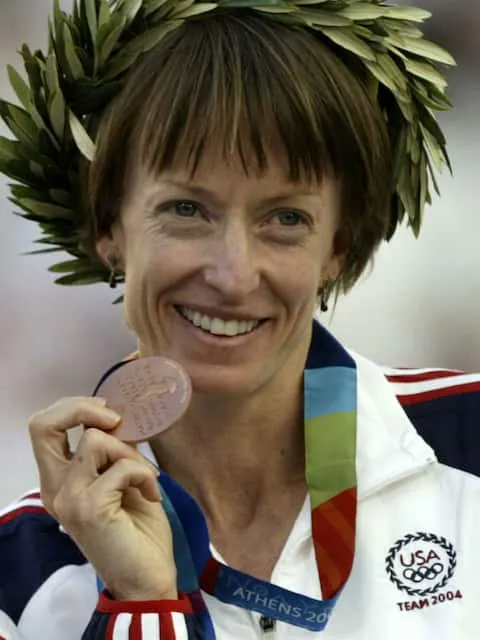
Deena Kastor - Athens Olympic Games
The book is a classic autobiography that American readers will appreciate more. They know the high school and college sports system and will probably value her achievements more. At the end of the book there are several exercises that (supposedly) help get a runner’s mind into the right state. Deena would certainly sign up to the phrase runners (not only ultrarunners) so often repeat: it’s all in the head.
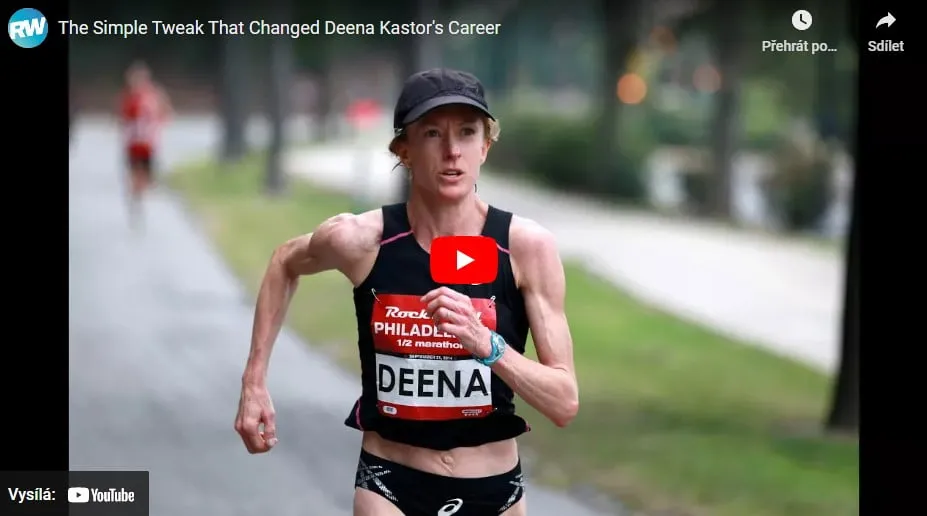
Her failure in Beijing didn’t break Deena. That’s confirmed by the fact that she holds the American Masters marathon record. She keeps running and runs for joy. And she wants to share that joy with you. So give her a chance. And if you don’t feel like reading the book, check out her Twitter. She tries to pass on her positive attitude there too.
Another review of the book
Deena Kastor is an American distance runner who, during her active career, was one of the best long-distance runners of her generation. She started with cross-country running and is best known as a marathoner: she won bronze at the Athens Olympics (2004) and still holds the American women’s marathon record (2:19:36; London 2006).
The book isn’t available in Czech, but speaking as an averagely competent reader of English, I can say it reads very well; the language is simple and clear.
The story begins when Deena Kastor is 11 and discovers her great talent at school cross-country championships. It then continues through her less glorious college years, when injury and the resulting loss of motivation made her want to hang up her running shoes, up to the beginning of her professional career in Alamosa, Colorado. In the main part of the book we follow Deena as she gradually becomes a world-class athlete.
First of all, I have to say that the title and subtitle are very accurate. The book is a kind of excursion into the author’s head: as a reader you live through important races, big victories and defeats with her. The idea of the book is positive thinking as a path not only to better sporting performance, but also to a happier and more fulfilled life. Yes, it sounds like a terrible cliché wafting from the “self-development” aisle, but believe me, the book is anything but a cliché.
Reading about her tough training sessions (“mile repeats” were one of Deena’s favourites), I felt the urge to put on my shoes and run outside, some passages were so idyllic! If I hadn’t been reading the book while ill, I probably really would have done it, only to discover soon after, to my surprise, that running still takes effort, not to mention the tough intervals the book often talks about.
What I really appreciate about the book is its “transferability” to everyday life. At the end of the book (at the twilight of her running career), Deena Kastor explains that through her desire to be faster and push the limits of her body, she got to know herself. And that very desire to be better carried over into everyday life. I really like this idea; it gives running (and sport in general) a different dimension, a greater importance. Even as amateur runners we often expose ourselves to discomfort, which is what shapes and strengthens us (or at least that’s what we can tell ourselves to justify our frequent absence from home).
PS: At the end of the book you’ll find “The Optimist’s Guide”, a guide to using positive thinking to achieve your own goals (not only running ones), inspired by the strategies Deena used to overcome hard moments in training and racing.
Kateřina Pospíšilová, @kacleen