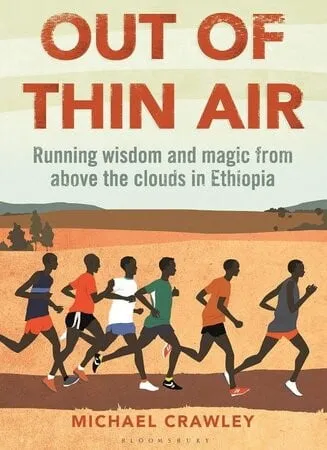
Out of thin air
In a nutshell
Anthropologist and runner Michael Crawley sums up years of training with Ethiopian runners: getting up before three in the morning, hills, cold water from a barrel and air above 3,000 metres. Above all, he knows how to observe and listen. Reviewed by Jan Havlíček.
Who it's for: Anyone curious about how Ethiopian runners train.
It isn’t easy to get up before three in the morning for a training run and get the long hills done before the streets get too busy, to settle for cold water from a barrel instead of a warm shower, to go in search of better air more than three thousand metres above sea level, or to leave comfortable paths and push through bushes on a steep slope. But it’s even harder to watch and listen to others without putting our own running and problems first. Michael Crawley managed it, and in Out of Thin Air he sums up the experience of more than a year in Ethiopia, where, as a runner and anthropologist, he studied the local running culture for his doctoral thesis.
The anthropological approach runs through the whole book. Crawley isn’t in Ethiopia to improve his personal bests. The fact that he’s a runner himself, with a 10 km PB of 30:07, serves mainly to help him join the local community more easily. He’s interested not so much in specific training sessions as in capturing a way of life, the overall picture of the culture from which some of the best runners on the planet emerge. In the end, individual sessions aren’t decisive for success (practically the only type of training likely to surprise readers is very slow off-path running in the forest). The emphasis is repeatedly placed on the need to train and to live in the right way (badenb in Amharic).
Only on the basis of training and living properly can we fulfil our potential, idil, the chances and possibilities we are given but which only God knows in full. Hence the faith-based conviction about everything we can achieve, because people don’t set their own limits, nor are they clearly determined in advance by innate talent and genetics. By being born we are given an opportunity that we can seize through persistent, honest training, a chance we can live up to by living properly.

For a long time I thought running training was a kind of laboratory, where new training methods are tested and the latest scientific findings are used as much as possible. In reality, it seems more like a workshop or a guild. That doesn’t necessarily rule out the idea of a laboratory, but mastering the craft is more important than technological and scientific novelties: long-term, consistent training work using often very simple means, handled thoughtfully and purposefully. Just running without thinking isn’t enough. In the very first chapter, coach Meseret says that only those who first watch and think, and only then run, can succeed. You need to be open and learn from others (not only from coaches, but also from other runners), make the most of the conditions you have and know what you’re doing and why.
As an example, Crawley gives the way Ethiopians manage to get the most out of the environment they train in, deliberately heading to places that best suit the goals of each session and the demands of the races they’re preparing for. Another key Ethiopian lesson for him is that nobody runs alone. Maybe you can run alone if you’re jogging for your health, but not if you want to achieve something. Not only do the runners learn from each other, they also draw strength from the group, from the fact that they’re not in it alone. As if we could run better when we manage to connect to something bigger than ourselves, whether it’s the surrounding environment or the community of runners: running with the land and together with others.

For Ethiopians, running is undoubtedly one of the few ways to really change their lives and make their mark. In many ways they approach it as work, but that doesn’t make it any less fun. Every run is different, every session can come with curiosity and discovery, it can become a game and an adventure. Setting off before dawn, heading into unknown, wild terrain, running at the limit of your abilities: what else is that if not adventure, and what else are those running with me if not companions on that adventure?

Michael Crawley teaches us to think about running and running training in new terms. Curiosity, play and adventure are among the most important, but far from the only ones. Ethiopian running culture, as he presents it in his book, is extraordinarily inspiring. But to become better runners, we don’t have to go to Ethiopia for a year. It’s enough to think more about our own running and set out on an adventure. All it takes is courage and enough determination.
This review was written by Jan Havlíček for the Czech running magazine B. Jan studied physical chemistry at the Faculty of Science of Charles University. He works as an editor. He coaches runners. In 2015 he co-founded B running magazine.
I can personally recommend the “magazine”. The quotation marks are well deserved, because we usually imagine something completely different under the word magazine. Every issue is a design gem, every issue is full of new ideas, every issue is a book… If you care about quality reading, without ads for super extra new shoes and the like, support the guys’ work and become a subscriber. Or at least try one issue. Have a look here.
David Bíbrlík