Running kind
In a nutshell
The story of a completely ordinary runner who started running by chance, and proof that anyone really can be a runner. Novelist Christine Stovell adds a short story set in the running world at the end. The descriptions of race after race do get tiring, though.
Who it's for: Beginner runners who need to hear they don't have to prove anything.
This book is different from all the previous ones. We’re used to reading incredible stories about running around Iceland, a marathon at the South Pole, running across the Sahara, setting a record on the Appalachian Trail or finishing Leadville 100 at retirement age. Compared with those, the story in this book is completely ordinary, even “uninteresting”. So why was the book written?
It’s the story of an ordinary person who started running more or less by chance. The book shows others that anyone really can become a runner. You don’t have to run a 10K, a half or a marathon to be a runner. Just put on the trainers you find in your wardrobe, pull on some old clothes and head out. Take one step after another. At that moment, you’ve become a runner.
Christine opens the book when she was approaching forty. Her marriage had fallen apart, she had lost her job and she had two small children to look after. There was nothing left but to move back in with her parents. She needed an escape from reality, and running gave her one. Not even the fact that she came back from her first run pretty battered changed that. Life literally threw obstacles under her feet. She didn’t give up and started running regularly.
She surprised herself. Until then she had seen running as something “reserved” only for real athletes. Before long she wasn’t running alone. After some shyness, she finally plucked up the courage and joined the local running club, Epsom Allsorts. At last she found people “afflicted” in the same way. Running started to give her much more. Then came her first Saturday runs in the park: parkrun. In England, where Christine lives, they have this really well set up. Every Saturday a 5 km (or rather 3.1 mile) race is run in many places. You just turn up on time, scan your barcode and run off with the others. What more motivation for running every day could you want? You beat yourself, climb the rankings, meet friends and egg each other on.
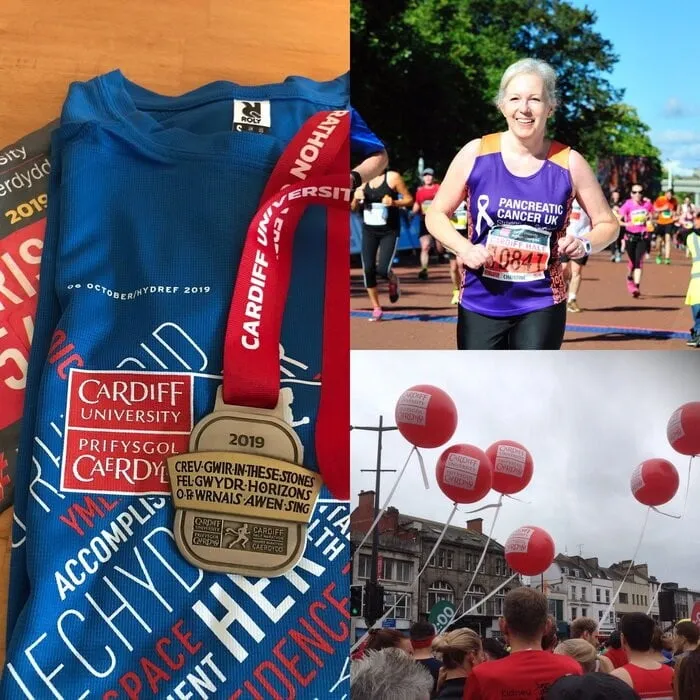
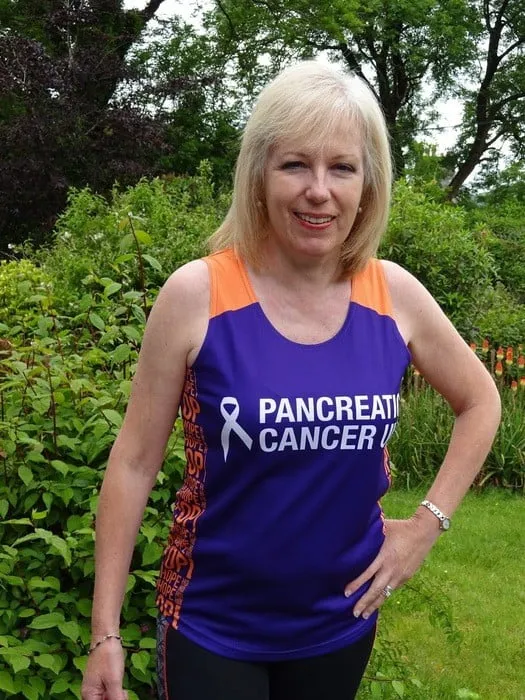
Before long, five kilometres wasn’t enough, and Christine went on to half marathons. She set herself a goal: two a year, one in spring and one in autumn. She didn’t need more, that was enough for her. Running also helped her through a hard time when her father died of pancreatic cancer. It gave her running a new impulse. Charity runs are very widespread, especially in the UK. When I ran the Surrey Half Marathon, I was probably the only one running just for myself. Runners here even collect money during the race itself. The proceeds go to the charity they’ve chosen to support. Christine had a clear choice. She knew it wouldn’t bring her father back, but maybe someone else wouldn’t have to die. Very idealistic, but lots of great things started thanks to ideals…
The end of the book is devoted to memories of the individual half marathons Christine ran. She mentions 14 of them in total, between 2008 and 2019. By then she was living in west Wales, so the pattern was simple: in spring always the Cardiff University Half Marathon and in autumn the Llanelli Half Marathon. They aren’t long notes, but reading for the seventh time about how she runs in Cardiff… Personally, I was surprised by the turnout of 25,000 runners. What didn’t surprise me was the weather.
The book actually has two endings. Christine isn’t just an enthusiastic runner but also a novelist. She couldn’t resist and added a short story as the real ending. Set in the running world, of course.