Run forever
In a nutshell
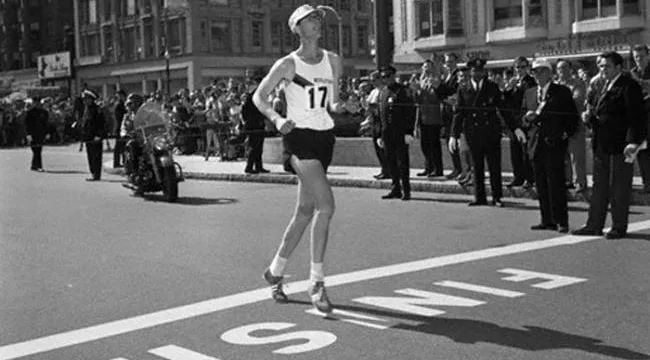
1968 Boston winner Amby Burfoot on how the running world has changed over his sixty-year career, why the brain is the most important part of a runner's body and how to run "forever". The main message: keep moving.
Who it's for: Anyone who wants to keep running as long as possible.
By chance I came across an episode of the Run to the Top podcast with Amby Burfoot (born 1946) as the guest. I didn’t know the name, but the episode description caught my eye. The 1968 Boston Marathon winner talks about how the running world has changed over the sixty years of his running career. Why he believes the brain is the most important part of a runner’s body, and how to make it possible to run “forever”. The hour-long conversation flew by as fast as the drive on the D1 motorway from Olomouc to Ostrava. By the time I got there, I knew I was buying another book. The book Run Forever.
Why buy a book by an author who was in his best shape in the year Czechoslovakia was waiting for Soviet tanks? Aren’t these just the yellowed pages of the past? No. The book came out in 2018, so besides memories of the past it also covers questions of the present. Its aim and mission is to offer a “manual” for running as long as possible. Fifty years after his win, Amby lined up at the start of the Boston Marathon again. At 71 he crossed the finish line in 4:53:22 (his personal best is 2:14:28). Who else should write a book like this? As the author himself puts it: “While none of us can prove for certain that running will add years to our life, there’s no doubt that running will add life to our years.”
An equally important reason to pick up this book is that Burfoot worked as a journalist for Runner’s World from 1978. He was there for everything important and, as he writes, he talked with hundreds of famous runners, Meb Keflezighi, Deena Kastor… but above all he has experience and knows how to write. The author’s better-known work, though, is First Ladies of Running: 22 Inspiring Profiles of the Rebels, Rulebreakers, and Visionaries Who Changed the Sport Forever. It was precisely at the end of the 1960s that the first women started appearing on the Boston Marathon course. No wonder this inspired Amby too. Just for interest, the first, unofficial one was Bobbi Gibb, who in 1966 jumped out of the bushes and joined the men. Although she was running up to 50 kilometres a day at the time, her application for an official start was rejected. Women aren’t built for the marathon, or so the official statement said. Lenka Kubková would certainly disagree in her book World Marathon Majors.
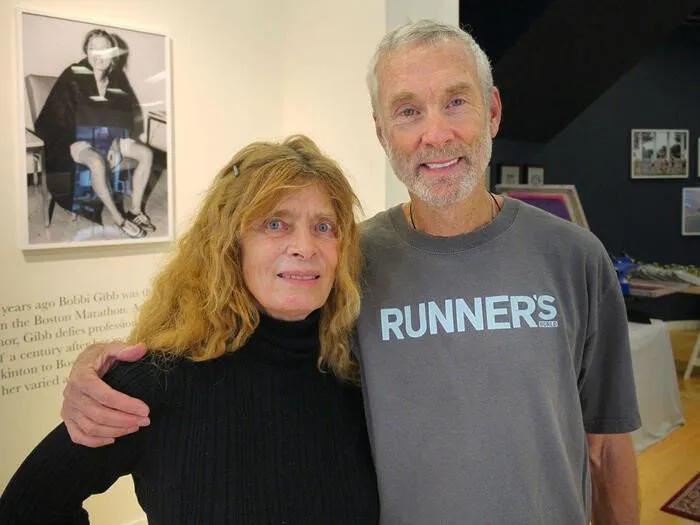
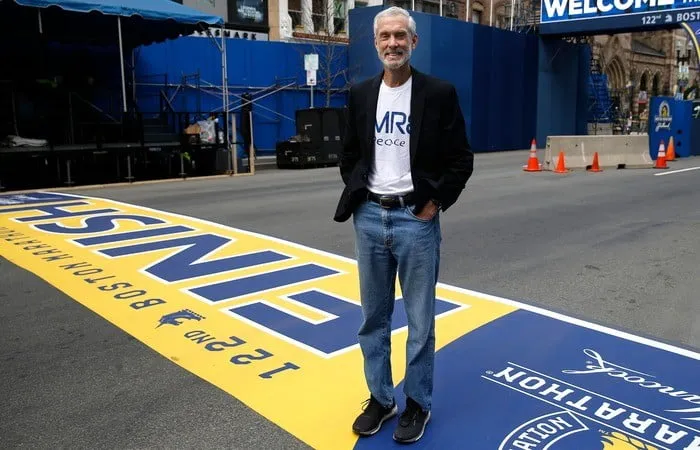
Years later - Bobbi Gibb and Amby Burfoot
The first official woman runner was Kathrine Switzer a year later, who finished a whole hour after Bobbi. Still, the world remembers her more, partly thanks to this iconic photograph. Interestingly, she comes from Syracuse, which became the new home of Lopez Lomong, the Sudanese refugee who made it all the way to the Olympics.
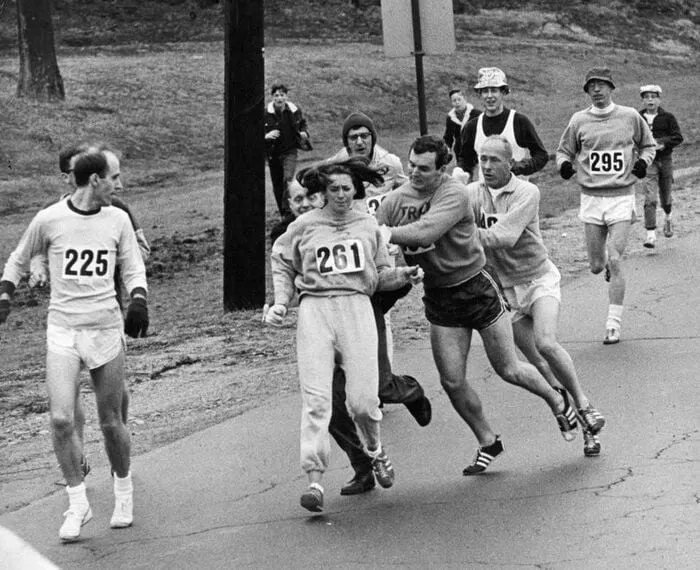
Kathrine Switzer
But back to Amby. The book couldn’t begin any other way than with memories of his early years. He was strongly influenced by his coach, the well-known John J. Kelley. He too won Boston, in 1957. In the book he’s described as a huge personality, especially as a human being. He influenced Amby not only in sport, but also in his lifestyle. Amby too became a vegetarian at seventeen. We also read other interesting things, for example about early research into the effects of hydration on running performance. It was a time when the Boston Marathon was run without refreshment stations. Amby was a guinea pig in one such project. Is it better to run without water, with water, or with the 1968 novelty and today’s best-selling sports drink brand, Gatorade? The result is surprising even years later.
The book consists of six main chapters. The first gives information and recommendations on how to start at all. It points out beginners’ most common problems. Don’t run fast and don’t track distance, but time on your feet. What other running habits and bad habits are there? Why not run with headphones at the start? What to eat after a run? There’s also a section on what gear you need. Here Amby directly warns against the conclusions of Born to Run: a minimalist shoe really isn’t the best choice for beginners. The second chapter is about eating habits. Which drinks to choose? What about tea and coffee? Probiotics, vitamins and supplements, vegetarianism and veganism. When and what to eat? We find out in twelve subchapters.
The third part of the book is about gradually increasing your mileage. Although it ends with two training plans, for a half marathon and a marathon, you’ll find more general advice here than plans for how far and how fast to run. Still, there’s one interesting concrete thing: the Yasso 800s (named after his colleague Bart Yasso). Are you aiming for, say, a 3:10 marathon? Try running 800 m in 3:10 minutes, 10 times in a row, with 3:10 minutes of walking between reps to recover. If you can do it, you can run a 3:10 marathon. There isn’t much logic to it, but supposedly it matches reality quite accurately.
The fourth chapter is one every runner would rather avoid. Injuries. Blisters, knees, Achilles tendons… but also, for example, the hidden danger of painkillers. Those who’ve been through it know; those who haven’t will find out. Here too there are practical insights. For example, there’s a group of fluoroquinolone-based antibiotics that can cause Achilles tendinitis. A list of drugs containing this substance is here. Is it even possible to prevent these injuries? Hard to say; it certainly helps not to forget mobility work and a “warm-up” before running.
The fifth chapter, “How to run faster”, is followed by the last one, “How to run forever”. The author himself has more than sixty years of running behind him and has covered more than 160,000 km. He’s no idealist and knows the book’s title can’t always be lived up to. Still, at the end of the book he introduces us to a doctor who had demonstrably run over 400,000 km by the age of 82. When he was younger he was hit by a car, so he bought a treadmill for his home and for the last twenty years he ran indoors. When he turned 86, he had an accident on the treadmill too. He realised his running days were over. The next day he bought a recumbent bike and started riding. He didn’t stop. He stayed in motion. And that’s probably the main message of this book. May you manage it too.